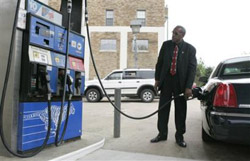
(AP File Photo)

Taking a harder look at possible gasoline price-gouging
ASK THIS | April 19, 2005

The research director of Public Citizen's Energy Program says the press is too quick to conclude that price increases are simply due to supply and demand. Reporters, he says, aren't asking the right questions.


By Tyson Slocum

tslocum@citizen.org

(202) 454-5191


Q. Are oil companies making part of their record profits off price gouging?


Q. Who exactly determines oil prices?  And how can we make sure they're not pulling an Enron?


Q. Can anything be done to tamp down speculation in the short term?


As oil and gasoline prices continue their steady climb, lots of stories are written concluding that the increases are attributable to supply and demand, pure and simple, and that the only solutions –- increasing domestic supply or reducing domestic demand –- are  long-term, so we're simply forced to deal with higher prices in the meantime. And OPEC gets branded as a primary culprit.


But that's not the whole story.


One of the first things to examine is the relationship between the record profits enjoyed by U.S. oil companies and the higher prices for consumers and American industry. For example, in 2004, ExxonMobil  –-  the product of the 1999 merger between Exxon and Mobil  –-  chalked up the world's biggest-ever profit for a single company: $25.3 billion.


Is it possible that ExxonMobil and other U.S. oil companies are making part of their profits off price gouging? It is possible that, just like Enron constricted supply in California by ordering power plants offline in order to create supply shortage to jack prices up, U.S. oil companies are keeping supplies offline and waiting to release those supplies until prices rise enough to make it worth their while?


The potential is there. According to the Energy Department, the U.S. is the 3rd largest producer of crude oil in the world (only Saudi Arabia and Russia produce more oil than we do), and we are far and away the largest consumer of oil, using 25 percent of the world's consumption every day. That makes the U.S the largest oil market in the world, and therefore actions in the U.S. help determine world oil prices.


The history is there. The U.S. Federal Trade Commission has in the past found that U.S. oil companies intentionally withheld supplies of gasoline from the market in order to drive prices up. In March 2001, the FTC concluded an  investigation into a spike in Midwest gasoline prices and found that one firm chose not to sell its excess supply because that "would have pushed down prices and thereby reduced the profitability" of its exsiting sales. "An executive of this company made clear that he would rather sell less gasoline and earn a higher margin on each gallon sold than sell more gasoline and earn a lower margin." The FTC didn't find any violations of antitrust laws because there was no collusion. But, it concluded: "In each instance, the firms chose strategies they thought would maximize their profits."


And it's easier now than ever. The consumer group Public Citizen, first in a May 2001 report, then in a March 2004 report, and then in Congressional testimony in May 2004 reported that recent mergers in the U.S. oil industry have greatly consolidated control over refining and marketing in the U.S., making it easier for a smaller group of companies to price-gouge. Don't believe consumer groups? Perhaps you'll believe the U.S. Government Accountability Office, which affirmed Public Citizen's conclusions in a recent report to Congress.


The evidence is in the numbers. The domestic gasoline price spread  –-  the price of a gallon of gas, minus the cost of crude oil and taxes –-  has increased by 30 percent from the mid-1990s to 2004. That spread measures the share of a gallon of gas charged by refiners and marketers. In the mid-to late-1990s, the domestic spread averaged 39 cents per gallon. But during the post-merger period from 2000-2004, the average domestic spread has been 51 cents. (See  Fueling Profits, a report by Mark N. Cooper for the Consumer Federation.) This translates to an increase in U.S. gasoline prices of $55 billion, the amount by which U.S. consumers have been price-gouged. It is no coincidence that oil corporation profits are at record highs.


And just like Enron falsely tried to blame California's environmental laws for causing the 2000-2001 energy crisis, the oil industry is trying to do the same today for higher oil and gas prices. Hopefully we won't get fooled again.


Now consider the rising price of crude oil. Who exactly determines oil prices? It sure isn't OPEC. The international cartel isn't what it used to be, as 75 percent of America's oil comes from non-OPEC sources, and quarterly announcements by the group that it's raising crude oil production are sometimes met by price increases on the oil trading exchanges.


Today, prices are determined on international exchanges based on what traders are willing to pay. And who are these folks trading oil and setting the price? Increasingly, they are hedge funds, investment banks, and others out to make a quick buck speculating on the price of oil. And while they're making money, the rest of us are paying for it.


As Simon Romero wrote for the New York Times on March 15, 2005: "Even as oil prices flirt with record highs, a growing number of people in the energy industry, including the chairman of ExxonMobil, are voicing concern over whether the soaring oil prices are justified by supply-and-demand conditions in the market. Some are even comparing the trading in energy markets to the speculative frenzy in technology stocks in the late 1990's."


A recent U.S. Senate report ("U.S. Strategic Petroleum Reserve: Recent Policy Has Increased Costs to Consumers But Not Overall U.S. Energy Security," prepared by the minority staff of the Permanent Subcommittee on Investigations, March 5, 2003) concluded that the trading markets that set oil prices are severely underregulated, opening the door to Enron-style manipulation of crude oil markets.


In fact, there's a strong chance that such manipulation is occurring right now, but the government isn't even allowed to collect the information necessary to make such a determination.


In response to Enron's fraud, Congress enacted sweeping new government regulations over two issues: campaign finance and the accounting industry. But the heart of the scandal -- manipulating energy markets -- Congress and regulators left untouched.


And remember, it was Enron and then-Texas Senator Phill Gramm who provided the biggest push to pass the energy trading deregulation bill in the first place  –- The Commodity Futures Modernization Act of 2000 (S. 2697, 106th Congress) passed during the lame duck session after the 2000 election.


The first step toward tamping down speculation would be to restore transparency to the speculative oil trading markets by re-regulating Over-the-Counter exchanges. In the past, amendments proposed by Senator Dianne Feinstein (D-Calif.) to do just that have failed. See the roll call votes for this proposed amendment in 2002, and this one in 2003.


Another useful step would be for the Department of Justice, the Federal Trade Commission and Congress to launch investigations into the ability of oil companies to utilize legal and illegal manipulation strategies to price-gouge consumers. 


-

Gouging? Guess again
Posted by just marc - Private citizen
10/27/2005, 04:22 PM

You know very little about Business unfortunately... and less about oil.

Oil companies have reaped the benefit a the increased WORLD Price, not gouging.

Increased (and international) pump price is the result of World demand.. China, India etc.

Mergers and intercompany competition have NOTHING to do with it.

Please reference for one, Conoco Phillips earnings of Yesteday.
The company made great gains in Drilling and Refining, but LOST money in marketing/the stations.
FAILING to be able to pass on the True/World oil price to the pumps and still sell gasoline.

This is not to say the refining operations didn't do great (much due to one time Katrina).
But these are International Prices, with Pump price going up less percentage-wise than Barrel Price.
INTERNATIONAL Barrel price.

Glad to help,


Price Gouging
Posted by Jerry F. Abbott - A retired taxpayer who is sick of greedy oil companies and politicians picking my pocket!
04/25/2006, 09:47 PM

I am a 73 year old retiree who is sick to death of greedy oil companies AND their political 'friends' picking my pocket! Our 'great' president, Mr. Bush is so far into bed with these people neither he nor anyone in his 'regime' will stop this. After all, the oil companies are the ones who helped Mr. Bush get 'elected' both times.
America is destined to fall before Mr. Bush leaves office...count on it! And he will be the main reason for it. We, the people, have allowed ourselves to become sheep being lead to the slaughter by big business and their political allies to the point there is no turning back. No cure for the incessant greed that grips our nation.
May God help us, because 'our' government surely won't!


Jerry's got it!
Posted by AndroidBoy
07/24/2008, 01:17 AM

I love that there's always some guy defending the way things are going. I wonder what these people would say if they were part of the Donner party? The voice of history should always speak louder than the words of the self-serving. Anybody who looks at the way America is heading and says, "This is good" probably wishes they lived in the Gilded Age.
We are not talking about companies...we are talking about corporations! They exist to make profits to the exclusion of anything else and we have given them free reign over America. Is it any wonder that they manipulate and gouge? Why wouldn't they? They don't have any morals or concern for any of us.
Fortunately, we do have options. Buy locally. Spend as little money as you can manage. Conscientiously avoid doing business with corporations. Quit shopping at Wal-Mart. Many times, there are better, less expensive options to meet our needs. Ignore advertising, it's all lies. If it comes down to it, we have the right to bear arms. If they keep pushing, then somebody is going to start pushing back. (This is not to say that I endorse the use of force...I don't want to end up in some secret prison after being rendered to a foreign government for "questioning").
The market used to be the thing that brought goods and services to you. Now, it is our ruler. I wish someone with political power would statrt telling the corporations that they need to play it straight or they'll get nationalized. We did it during World War I. I'm not a communist, but it's time to get their attention, and that would do the trick!


-

Bruce Kushnick
Is basic American telephone service in a death spiral?
Bruce Kushnick questions whether AT&T and Verizon are trying to kill off the “plain old telephone service” that millions of Americans rely on. In a recent FCC filing cited by Kushnick, AT&T stated that landline utilities are from a bygone era, and asked to be relieved of its obligations to service them.

George Wilson
Obama gave a pass to out-of-control military spending
The GAO showed that contractors’ estimates have nothing to do with reality, and economic hard times may eventually force the President and Congress to rein in outrageously costly warships, planes and missile systems that don’t work. But that time isn’t here yet.

Martin Lobel
Some remedies for the Supreme Court power grab
It’s easy to find activism, impossible to find original intent behind the Roberts/Scalia group’s ruling on corporate political spending. Martin Lobel suggests six sharp, practical steps to deal with it.

Watchdog Blog
Barry Sussman
Scratch the Big Bonuses and Turn Them Over to Borrowers?
As an old assignment editor I’m used to asking questions and not being embarrassed if they expose me as naïve or wrong minded, because sometimes there’s a good story lurking. So here are a few simple questions. The biggest financial institutions are said to be on the verge of issuing $145 billion in bonuses. My [...]

Barry Sussman
A Simple Solution for Corporate ‘Free Speech’
A friend and contributor to Nieman Watchdog, Martin Lobel, sent this emaiI with the suggestion that people pass it along. Looks worth passing along to me. Here’s Marty: “I don’t know whether you’re as upset with the Supreme Court’s legislating in Citizens United v. FEC as I am, but there is a simple solution that is [...]

George Lardner Jr.
No 60 Votes Needed Here
Item: The New York Times reported Friday afternoon that “two more Democratic senators” said they would vote against a second term for Fed Reserve chairman Ben Bernanke. From there, the Times said this made it unclear “whether there were the 60 votes necessary to confirm Mr. Bernanke.” Excuse me? Sixty votes are not necessary to [...]

Blog main page >>
Web Essentials
Leading journalism sites, blogs...
Enter your e-mail address
Spotlight On

TWITTER
Follow Nieman Watchdog on Twitter.
(Nieman Watchdog)

Torture probe abandoned
For lack of interest, the Senate will not move ahead on the idea to appoint a commission to investigate detention, rendition and interrogation policies by the U.S. during the George W. Bush administration.
(Secrecy News)

Find John Brennan's op ed
Harry Shearer, working from a fantasy assignment desk, wants reporters to find a 2005 anti-Iraq war op ed that never was published.
(Huffington Post)

Those Mohammed cartoons
On Jan 2 a man with an axe tried to attack the Danish artist whose 12 depictions of the prophet Mohammed created a furor in 2005. After the failed attack, a Norwegian newspaper reprinted six of the drawings.
(Editors Weblog)

Afghanistan surge to rely heavily on private contractors
Private contractors are expected to make up at least half of the total military workforce in Afghanistan, according to Defense Department officials cited in a recent study from the Congressional Research Service. The number of contractors will likely increase by between 16,000 and 56,000 for a total of 120,000-160,000.
(TPM Muckraker)

Recession scars will be lasting
The aftershocks from deep recessions reverberate for years, even decades.
(USA Today)

The curious spending of a GOP pro-choice PAC
The money doesn't seem to actually go to supporting choice.
(Center for Public Integrity)

More Spotlights >>