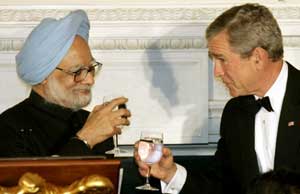
President Bush and Indian Prime Minister Manmohan Singh toast each other at the White House in July. (AP)
 |
Will President Bush's 'one big idea' turn out to be a bad one?
ASK THIS | August 238, 2005
The president’s longstanding desire for closer relations with India led to his dramatic proposal in July to share nuclear technology with India. But Brookings Institution scholar Stephen Cohen thinks reporters should be exploring what the fallout would be in such areas as non-proliferation and relations with China.
By Stephen Philip Cohen
scohen@brookings.edu
Q. Will the new US-India relationship trigger a counter-response from those states that might regard it as threatening—notably Pakistan and China—possibly speeding up the Asian arms race?
Q. Will it induce other states to accelerate their own covert nuclear weapons programs?
Q. Has the Bush administration miscalculated India’s ability to keep its side of the bargain, and can the present state of very good US-Indian relations survive the failure of the nuclear deal?
Q. Even if India does deliver, what assurances does the Bush administration have that a nuclear-armed and fast-growing India will remain a "natural ally" of the United States?
People close to President Bush, notably former Ambassador Robert Blackwill, have often stated that back when Bush was governor of Texas, he had “one big idea” regarding foreign policy, and that idea was India.
Blackwill, who was one of the original close-knit group of advisors known as the Vulcans, notes that Bush came into contact with Austin’s Indian-American IT community and was duly impressed. Bush later envisioned a strategic relationship with New Delhi, one that might potentially balance out China. Further, as the world’s largest democracy, India fit into Bush’s strategy of democracy-promotion.
One early target of the Bush administration was the sanctions imposed upon India (and Pakistan) as a result of their 1998 nuclear tests, and these were removed early in Bush’s first term, to the howls of the non-proliferation community. Then followed the appointment of Blackwill as ambassador to India, and joint US-India military exercises. A planned presidential visit to India, disrupted by 9/11, is now set for early 2006.
However, a major obstacle to India-US normalization is an American law: The 1978 Nuclear Non-proliferation Act (NNPA). India’s clandestine nuclear program has been a bone of contention between it and the United States ever since India’s 1974 nuclear tests, which led directly to the passage of the NNPA.
In a dramatic announcement last month, Bush and the visiting Indian prime minister, Manmohan Singh, agreed to take steps that would allow the full flow of civilian nuclear technology to India, in exchange for India becoming a de facto member of the Nuclear Non-Proliferation Treaty (NPT). India cannot become a formal member of the NPT because it tested a nuclear device after the treaty went into effect in 1968.
The nuclear dimension of the Bush-Singh communiqué brought headlines in both India and the United States. The agreement was supported by Mohammed el Baradei, the Director of the International Atomic Energy Agency (IAEA), and by Great Britain, but other countries are wary, with China so far remaining silent.
A major debate is shaping up here and in India.
In Washington this debate will be over the administration’s request to Congress to modify the NNPA to permit the flow of nuclear technology to India.
In India there is some question as to whether New Delhi should abide by whatever changes are made in the NNPA, some of which might limit India’s military nuclear program.
While I have for many years advocated a grand bargain in which India accepts certain restraints on its military nuclear program in exchange for civilian nuclear technology, I foresee a number of problems:
Politically, the potential deal has divided Republicans and Democrats, liberals and conservatives. While everyone is opposed to nuclear proliferation, there is already strong disagreement as to whether the deal will advance or retard this goal. The administration’s secrecy and its unwillingness to consult even with Congressional leaders may make it harder to build support for the necessary changes in legislation.
A second political calculation is the role of the India lobby, which has become moderately influential, as American stereotypes of India have changed from highly negative to highly positive. Yet, will pro-Indian legislators vote against the deal because they believe it hurts the cause of non-proliferation?
Almost all of the publicity surrounds the nuclear and proliferation component of the communiqué. Lost in the shuffle are significant agreements over business cooperation (a forum of India and American CEO’s), American assistance to India’s faltering agricultural sector, and the potential for greatly expanded defense cooperation. If the administration is unable to bring about a change in the NNPA (or if India is unable to meet the criteria that Congress builds into the new Act), what happens to the rest of the US-India relationship? Has Bush put it at risk by proposing a deal that may be politically difficult to bring off?
Will the new US-India relationship trigger a counter-response from those states that might regard it as threatening—notably Pakistan and China—possibly speeding up the Asian arms race? And will it induce other states to accelerate their own covert nuclear weapons programs? The administration’s calculation is that Israel and Pakistan might be brought into a new halfway" house regime, something short of the NPT, but is this calculation correct?
Also: Has the Bush administration miscalculated India’s ability to keep its side of the bargain? Indian law will have to be rewritten and New Delhi’s military nuclear program will be circumscribed. Will Manmohan Singh’s coalition government, kept in power by anti-American communist and left parties, be able to deliver?
Even if India does deliver, what assurances does the Bush administration have that a nuclear-armed, and fast-growing India will remain a "natural ally" of the United States? In the past, some of our allies have decided that the US alliance is disposable or discretionary (for example: Iran’s reversal after the Shah, France and Germany’s decision to stay out of Iraq). Might this major change in American law and policy simply make it easier for India to continue to pursue an independent policy, one that often runs counter to American interests?
Conversely, if either the US or India are unable to deliver on the nuclear component of the agreement, will the present excellent status of US-Indian relations be unaffected? There are growing economic and political ties between New Delhi and Washington, are they strong enough to surive the collapse of the nuclear center-piece of the summit?
These questions deserve careful attention. The answers will determine whether Bush’s long-cherished visit to India will be a fiasco or one of the great successes of his two tumultuous terms as president.
|
|
Stephen Cohen has been a Senior Fellow in the Foreign Policy Studies Program of the Brookings Institution since 1998. He was a member of the Policy Planning Staff of State from 1985-87, and is the author of numerous books and articles on India and South Asia, notably the recently published India: Emerging Power (Brookings, 2001), and The Idea of Pakistan (Brookings: 2004). 
E-mail: scohen@brookings.edu
|