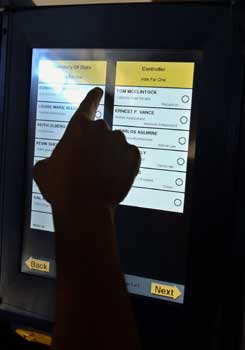
Paperless voting demonstration. (AP photo)

The perils of paperless e-voting
ASK THIS | July 08, 2005

Let’s say your state or local election officials have a paperless e-voting system or are thinking about switching to one. Here are some questions you should ask to see if they’ve really thought it through.


By David Dill

dill@cs.stanford.edu


Q. There has been a lot of controversy about electronic voting in the last few years. In particular, it seems that many experts in computer technology have grave concerns about the trustworthiness of paperless electronic voting. Have you sought advice from computer experts? Have you spoken with experts opposed to paperless systems? (The answer is almost certainly "no", but if it is "yes", who were they, and why did you not find those arguments convincing?)


Q. There have been several cases in the last few years where paperless systems have irretrievably lost votes. Suppose that the vote totals reported by the machines seem suspicious. How are you going to do a recount? (If the answer is that they'll print the paper ballots from memory and count them, the obvious follow up is: Why would this satisfy a candidate? If the votes were not recorded properly, won't the paper printouts have the same problems as the electronic records? That's not the same as recounting ballots that the voter was able to check, is it?)


Q. At this point, over 20 states have passed laws requiring voter verified paper records, and there are several bills pending in the U.S. Congress that would do the same. Aren't you bucking a trend here? What will you do if a paper ballot requirement is imposed in the future?


Q. Unlike paperless systems, precinct-count optical scan systems call for voters to fill out a ballot and put it in a scanner, which counts the votes and stores the ballot in a secure manner. There is strong evidence that such systems are not only much less expensive to acquire, but less costly to maintain, than paperless systems.  For example, Miami-Dade County recently proposed scrapping the paperless systems they bought for over $20 million less than three years ago because of the ongoing costs of maintaining those systems. Have you done a careful cost comparison -- and, if so, would you release it? Why do you feel that buying a paperless system is cost-effective?


Hundreds of computer technologists and thousands of others have endorsed this resolution, which concludes that unauditable voting equipment will erode confidence in our elections, causing further disillusionment of the voting public.


Here are definitions for some key terms:


Paperless e-voting or Direct Recording Electronic voting machines (DREs): Electronic voting machines that store an electronic ballot internally.  The problem with these machines is that the machine can show the voter a vote for candidate A but record a vote for candidate B internally, without the voter detecting it. There is no way to do a meaningful recount on these machines. The machine just echos the same numbers it produced the first time, or, more expensively, prints paper copies of the electronic ballots
stored internally.

Voter verified paper ballots (VVPB):  A paper ballot that the voter can inspect before casting.  The votes on the paper ballots themselves are counted.

Optical scan systems:  The ballot is like a standardized exam. The voter fills in "bubbles" or inks in a gap in an arrow. The ballots are counted by machine, either in the central office or at the precinct.

Precinct Count Optical scan: An optical scan system where the ballot scanner is in the precinct.  The voter or someone else puts the ballot in the scanner, which counts the votes and stores the ballot in a secure manner.  If so configured, the machines can reject the ballot if it can't be read properly.  Precinct count systems have been studied extensively by political scientists, who have found them to be much less conducive to voter error than punch cards.  In this respect they are competitive (perhaps better) than DREs.  Precinct count optical scan systems are very widely used in the United States.

Voter verified paper records (or audit trails): A paper record of the vote that the voter can inspect before casting. Votes can be stored and counted electronically, but the paper records are available for manual audits or recounts.
-

FAQ on Paperless Systems
From the Verified Voting Foundation.

E-Voting Misconceptions

Accessible Voting

Martin Lobel
It’s time to do more than just say the economy is the No. 1 issue
If voters are to go into the midterm elections with any understanding at all, the press needs to get away from he-said, she-said reporting and look into the positions that candidates and the two parties are taking. Martin Lobel offers some vital questions.

William Claiborne
What a broken Senate looks like from far away...and why it matters
Our correspondent in Australia has ideas on how to improve things a little. But he’s not optimistic that anyone on Capitol Hill will be interested.

Steven Greenhut
How severe is the public employee pension problem across the U.S.? (Hint: Is a $3 trillion debt severe?)
Columnist and author Steven Greenhut looks at the ongoing pension issue, including abuses of it, and deals with some of the key questions.

Watchdog Blog
Herb Strentz
Des Moines Fair Coverage, Part 2
Cleaning up in the wake of the 2010 Iowa State Fair will be daunting this year. In addition to the mess left by nearly 1 million visitors and thousands of farm animals, we have a continuing saga of news coverage that told of possible racial assaults and then, in Saturday Night Live fashion, appears [...]

Herb Strentz
On ‘Beat Whitey Night’ in Des Moines
(Editor’s note: The incidents described here have become part of a developing story, as this Google link shows.) The Des Moines Register’s reluctance to identify criminal suspects or victims by race has turned into an outright refusal to do so. The closing night of the Iowa State Fair was marked by an observance not exactly on the [...]

Barry Sussman
Justice Department Shows Its Mettle, Indicts Clemens
I got this note from a friend and colleague a little while after Roger Clemens was indicted by a federal grand jury on Aug. 19th: “And meanwhile, Condoleezza Rice, Donald Rumsfeld, CIA officials and others who lied to Congress in sworn testimony about Iraq go free. If we can ‘look forward, not backward’ on torture, perjury, [...]

Blog main page >>
Web Essentials
Leading journalism sites, blogs...
Enter your e-mail address
Spotlight On

TWITTER
Follow Nieman Watchdog on Twitter.
(Nieman Watchdog)

Telecoms charging more to do nothing
It's getting more expensive to have an unlisted phone number. What's the logic behind that?
(Center for Media and Democracy)

Prosecute those leaks
The Obama administration has indicted another alleged leaker, this time for reportedly passing along to Fox News an intelligence assessment that North Korea was likely to respond to U.N. sanctions by conducting another nuclear test.
(Secrecy News/Federation of American Scientists)

A broad array of massive financial crimes
As PRWatch.org shows, court-imposed settlements have only skimmed the surface of big banks' wrongdoing in the financial crisis.
(Center for Media and Democracy)

More Spotlights >>