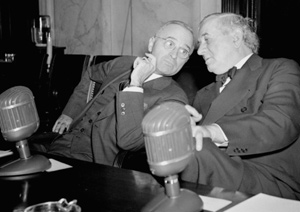
Then-senator Harry Truman shown with Sen. Tom Connally of Texas in 1941, the year the Truman Committee was formed to investigate the U.S. defense program. (AP photo)

Will Congress create a new 'Truman Committee?'
ASK THIS | January 05, 2007

In December, Nancy Pelosi said Democrats would dig into what she called staggering, breathtaking corruption in Iraq War contracting. Now they’re in position to do it. Will they, and if they do, what are chances they’ll have anywhere near the success of the World War II era Truman Committee?


By Nick Schwellenbach
schwellenbach@niemanwatchdog.org

Q. Will the Democrats create an investigative committee modeled after the World War II Truman committee to explore waste, fraud and abuse and reform the vast government contracting system as they said they would?

Q. If they do, will it be bi-partisan in nature?

Q. Would such a committee be focused—this is not an "either or" question—on preventing problems in the future or on uncovering past abuses?

Q. Why would such a committee be more successful than numerous past entities created by both the Legislative and Executive branches to reform contracting?

Q. How would such a committee deal with jurisdictional overlaps with existing Congressional committees such as the Armed Services, Appropriations and Government Reform/Affairs committees, some of which are chaired by headstrong House members and Senators?

Q. And what would be the scope of this committee?

Speaker of the House Nancy Pelosi told reporters in December that Democrats will seek "a Truman Commission-like initiative to follow the contracting. The corruption in contracting in Iraq is staggering. It's breathtaking." While in the minority, Democrats on the House Appropriations Committee argued for a "Truman" investigative committee to root out waste, fraud and abuse in the tens, if not hundreds, of billions spent on Iraq and Katrina reconstruction contracts.

The Truman Committee is considered one of Congress' most successful special investigative committees. From its creation in 1941 until 1948, when its mandate ended, the Truman Committee, named after then-Senator Harry S. Truman who first chaired it, held "432 hearings and 300 executive sessions, went on hundreds of fact-finding missions, and issued 51 reports," according to a Democratic report on the Committee Its work saved billions of taxpayer dollars and possibly also saved the lives of soldiers. It had a considerable positive impact on improving America's bang for the buck during World War II.

Despite some rosy accounts, however, the Committee was not above entirely politics. President Franklin D. Roosevelt was not enthused with the idea of a Congressional committee investigating the Executive's handling of the war. During the Civil War, Congress created a Committee on the Conduct of the War which criticized the Lincoln administration’s tactics and strategy, interfering with his prosecution of the war. It "weakened Lincoln's control of his Administration throughout the war," wrote Donald H. Riddle in a book, The Truman Committee: A Study in Congressional Responsibility.


A close ally of Roosevelt, Senator James F. Byrnes, held up Truman's resolution to create a Senate investigating committee. But when the much more firebrand Representative E. Eugene Cox threatened to create an investigating committee through the House, Byrnes moved the Truman Senate Resolution forward to thwart Cox. According to pollster Samuel Lubell who worked for Byrnes, Byrnes eased Roosevelt's fears of Cox-led investigations by telling him, "I can fix that by putting the investigation into friendly hands," referring to Truman.

Though not immune from political maneuvers and pressure, Truman’s committee, created and run by a Democratic Congress, investigated activities taking place under a Democratic President while a world war engulfed almost every continent. And it operated in a bi-partisan fashion, by and large.

Given broad powers, the Truman Committee was authorized and directed to make a full and complete study of the national defense program, including:

  1. the types and terms of contracts awarded;
  2. the methods by which contracts are awarded and contractors selected;
  3. the utilization of small businesses;
  4. the geographic distribution of contracts and the locations of plants and facilities;
  5. the effect of the defense program on labor and the migration of labor;
  6. the performance of contracts and the accountings required of contractors;
  7. benefits accruing to contractors with respect to amortization for the purposes of taxation or otherwise;
  8. practices of management or labor, and prices, fees, and charges, which interfere with or unduly increase the costs of the program;
  9. such other matters as the committee deems appropriate.

Some of these, such as the effect on migration of labor, are not relevant today, but most are fundamental issues that a potential special Truman-style committee and the relevant standing committees should investigate.

If Congress creates a special committee to investigate contracting in Iraq, Katrina reconstruction or other spending issues, that committee should take a look at investigations previously made by groups such as the Acquisition Advisory Panel (also known as the “1423 Panel”),which just completed its draft final report.

A Truman-style committee, if properly designed and run, could assist in saving billions of taxpayer dollars. Perhaps it would finally tackle the black hole that is Pentagon spending—by far the largest slice of the federal government’s discretionary budget pie. The Center for Public Integrity found in a report that fully half of the Pentagon’s budget went to contractors. As was noted by Winslow Wheeler in an earlier piece on this Web site, trillions of dollars in Pentagon spending have been deemed unauditable. I don’t envy them, but a group of thoughtful, empowered people need to tackle the mess with our contracting system.

-

Makes a Lot of Sense
Posted by R C - Ra Conteur
01/05/2007, 09:40 PM

Aside from the fact that such a committee and its investigations would be dangerous... It should be done. We cannot expect to wave a banner with the colors of democracy if the people whom constitute the democracy have no view of its operation. And it would be appropriate to call the committee a "Truman Committee" in deference to its predecessor. Looking forward to following this story Nick.


The Truman Commission
Posted by March Dancer - My role? I am a concerned American voter, a long-time Republican activist who has been converted due to the actions of that party themselves. My objective? A truth (found in various ways) that I can share with those who will listen. My disappointment? The rise of American "Christian" fundamentalist religion in lieu of "..faith, hope, love and charity, but..the greatest of these is love."
01/07/2007, 03:36 AM

I certainly do like the suggestion of naming this new committee, if such there is to be, The Truman Commission with all of the play on the respectability of the first commission that could be mustered. Human nature: harder to be a crook and/or liar if you're a member of a highly respected chosen smaller group of elected Representatives. America's eyes would be even more watchful.

I cannot imagine recovering any funds mis-spent to this date or yanking any no-bid contracts. Just a beginning of a regularly meeting Commission, watched by national media, would seem to me to cause a sudden tightening of contractors' activities.

Perhaps some intrepid reporter would start regularly asking why our troops are having their better built supplies sent to them by private groups from the concerned citizens of our U.S. Maybe another would even be moved to ask where the monies for the repair of vehicles and weapons has been spent.

I sure hope I'm not disappointed in my hopes for this next two years. If this new House creates openess, can good reporters be far behind with their supportive questioning of our elected and appointed officials?


-

Bruce Kushnick
Is basic American telephone service in a death spiral?
Bruce Kushnick questions whether AT&T and Verizon are trying to kill off the “plain old telephone service” that millions of Americans rely on. In a recent FCC filing cited by Kushnick, AT&T stated that landline utilities are from a bygone era, and asked to be relieved of its obligations to service them.

George Wilson
Obama gave a pass to out-of-control military spending
The GAO showed that contractors’ estimates have nothing to do with reality, and economic hard times may eventually force the President and Congress to rein in outrageously costly warships, planes and missile systems that don’t work. But that time isn’t here yet.

Martin Lobel
Some remedies for the Supreme Court power grab
It’s easy to find activism, impossible to find original intent behind the Roberts/Scalia group’s ruling on corporate political spending. Martin Lobel suggests six sharp, practical steps to deal with it.

Watchdog Blog
Barry Sussman
Scratch the Big Bonuses and Turn Them Over to Borrowers?
As an old assignment editor I’m used to asking questions and not being embarrassed if they expose me as naïve or wrong minded, because sometimes there’s a good story lurking. So here are a few simple questions. The biggest financial institutions are said to be on the verge of issuing $145 billion in bonuses. My [...]

Barry Sussman
A Simple Solution for Corporate ‘Free Speech’
A friend and contributor to Nieman Watchdog, Martin Lobel, sent this emaiI with the suggestion that people pass it along. Looks worth passing along to me. Here’s Marty: “I don’t know whether you’re as upset with the Supreme Court’s legislating in Citizens United v. FEC as I am, but there is a simple solution that is [...]

George Lardner Jr.
No 60 Votes Needed Here
Item: The New York Times reported Friday afternoon that “two more Democratic senators” said they would vote against a second term for Fed Reserve chairman Ben Bernanke. From there, the Times said this made it unclear “whether there were the 60 votes necessary to confirm Mr. Bernanke.” Excuse me? Sixty votes are not necessary to [...]

Blog main page >>
Web Essentials
Leading journalism sites, blogs...
Enter your e-mail address
Spotlight On

TWITTER
Follow Nieman Watchdog on Twitter.
(Nieman Watchdog)

Torture probe abandoned
For lack of interest, the Senate will not move ahead on the idea to appoint a commission to investigate detention, rendition and interrogation policies by the U.S. during the George W. Bush administration.
(Secrecy News)

Find John Brennan's op ed
Harry Shearer, working from a fantasy assignment desk, wants reporters to find a 2005 anti-Iraq war op ed that never was published.
(Huffington Post)

Those Mohammed cartoons
On Jan 2 a man with an axe tried to attack the Danish artist whose 12 depictions of the prophet Mohammed created a furor in 2005. After the failed attack, a Norwegian newspaper reprinted six of the drawings.
(Editors Weblog)

Afghanistan surge to rely heavily on private contractors
Private contractors are expected to make up at least half of the total military workforce in Afghanistan, according to Defense Department officials cited in a recent study from the Congressional Research Service. The number of contractors will likely increase by between 16,000 and 56,000 for a total of 120,000-160,000.
(TPM Muckraker)

Recession scars will be lasting
The aftershocks from deep recessions reverberate for years, even decades.
(USA Today)

The curious spending of a GOP pro-choice PAC
The money doesn't seem to actually go to supporting choice.
(Center for Public Integrity)

More Spotlights >>