| Home | Blog | Ask This | Showcase | Commentary | Comments | About Us | Contributors | Contact Us |


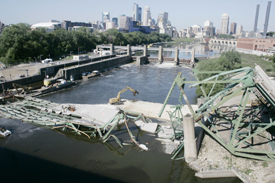
Bush broke the government. So who's going to fix it?ASK THIS | July 199, 2008You don't have to be a Washington policy wonk to notice that our government has ceased to function on many levels. A veteran budget expert writes that the political candidates who will inherit Bush's mess need to be asked what they're going to do restore the government to working order. By Pete Davis When people ask me who I want to win the presidency on November 4th, I say, "I just want the government to function again." On Capitol Hill, I worked for Republicans and Democrats. I learned that government functioned best when Republican and Democrats worked together, traveled together, ate together, and compromised together. The earned income tax credit I formulated and helped enact in 1975 was a Republican idea passed by Democrats. Bill Clinton pushed welfare reform into existence, and George W. Bush expanded Medicare to cover prescription drugs. There's a pattern there, but it hasn’t been followed in a long time. You don't have to be a Washington policy wonk to notice that our government has ceased to function on many levels. Ronald Reagan ran against the government, but it still worked under him, even after firing the air traffic controllers. Newt Gingrich led the radical conservative charge that literally shut the government down in the fall of 1996. That's when the real damage started. Worse was to come. President George W. Bush and his appointees have attacked the heart and soul of agency after agency and have soured relations with both parties in Congress, almost like Lou Gehrig’s disease, an autoimmune response gone awry. It’s one thing for a presidential appointee to order a policy change. But it’s quite another to ignore the law. It’s quite another thing to rid the government of the people needed to make it function. It’s quite another thing to flout Congress’s oversight, so public opinion only focuses on governmental failure and wrongdoing well after the fact. We hold ourselves out as a “nation of laws, not men.” Then why have we had an unprecedented number of lawsuits against the government seeking court support for the law? Too many government agencies are undermining the law. Our recent history includes the illegal wiretapping without court orders post 9/11. The EPA stopped going after polluters, despite clear violations of the law. The FCC overlooked the expansion of Rupert Murdoch’s media empire beyond statutory limits. The FDA rushed drug approvals without regard for required verification. The Justice Department found ways around clear prohibitions against torture and due process for Guantanamo detainees. For the first time in history, federal prosecutors were summarily fired for failing to pursue charges of election fraud for lack of evidence. Enron’s outright frauds were overlooked at the federal level until well after states’ attorneys started winning cases. Presidents swear to uphold the Constitution. That means they’re supposed to uphold the laws, all of them -- and to attempt to change the laws they don’t like. President Bush didn’t have as much success with that last step as he wanted, even with his own party in control of Congress through 2006, so he ignored laws. He turned presidential signing statements into extra-Constitutional line-item vetoes. If you were a career federal employee trying to uphold the law, what would you do under these circumstances? Those who objected were punished, sometimes severely. An entire team of Justice Department lawyers quit as a group. A steady parade of whistleblowers have testified on Capitol Hill and were demoted and shunted aside when they came back to work. A patchwork of federal whistleblower protection statutes have been enacted over the years to protect them, but that all came crashing down on May 30, 2006, when the Supreme Court, in a 5-4 decision in Garcetti v. Ceballos, ruled that government employees have no First Amendment protections for what they say on the job. The message to remaining employees is clear. Keep your own views of the law to yourself or get out. Many have left the government. This wouldn’t necessarily have been so destructive to governmental function if Congress had upheld its oversight functions. When Congress focuses public attention on governmental failings, corrective actions often result. Unfortunately, under President Bush until 2007 when the Democrats took over, Congress abdicated its oversight authority. Governmental function deteriorated outside of public view until we had a big wake-up call in the aftermath of Hurricane Katrina on August 29, 2005. The spectacle of governmental failure was only too clear. Three years later, and Congress is still trying to extract information about formaldehyde in trailers. So here are some of the questions I would like reporters to ask this year's candidates: Q. How many more natural disasters is it going to take before we revitalize FEMA? Q. How many more food poisonings and tainted drug imports is it going to take before the FDA can protect us again? Q. When is the EPA going to start enforcing air and water quality standards again? You know something is wrong when an agency is repeatedly sued to get it to enforce present law. Q. Why didn’t federal financial regulators move in to stop the housing bubble? Or Enron before that? Q. Why couldn’t the Interior Department collect oil and gas royalties owed? Or keep track of reparations due Indian Tribes? Q. Why has our nation’s highway, bridge, and rail infrastructure declined to its worst point since the Depression? Q. How many more failures to move air traffic is it going to take before FAA technology enters this century? Q. Why did the FAA fail to inspect Southwest Airline planes according to schedule and then punish the whistleblowers who drew attention to it? Q. When will we ever be able to conduct the census electronically in the country that invented high tech? Q. When will the government protect sensitive personal information from theft, careless loss, and snoopy State Department Passport Office employees? Q. When will we stop losing track of our own nuclear weapons? Q. When will we provide our returning veterans the mental health care they need to reduce their record suicide rate? Q. Why is K-12 education failing so many students despite No Child Left Behind? Q. Bottom line: Are we better defended? Is our economy stronger? Has our energy security improved? Are we leaving a better future for our children than we enjoyed? Post 9/11, President Bush used his carte blanche to fight terrorism, to launch a war, and to cut taxes. If measured by domestic terrorist attacks, we are still secure. However, Osama bin Laden remains at large, Iraq and Afghanistan are limping along, and, by all accounts, our armed forces are exhausted. My Republican friends who ventured to Baghdad during the summer of 2003 to restore Iraq's government have returned disillusioned by the opportunities that were squandered because of misguided ideology refuted by facts on the ground. A $5.6 trillion 10-year surplus in 2001 has been turned into a $2.4 trillion deficit in 2009. The real estate bubble has burst and high energy prices threaten the economy. The middle class is getting squeezed, and the poor are suffering. Our delay until last December in enacting a modicum of sensible energy policies has left us quite vulnerable to our dependence upon foreign oil for 58% of our oil consumption. Worst of all, our kids are entering their working careers carrying record amounts of private debt, mostly to finance their education, and facing unprecedented future federal debt from the war, the extension of the Bush tax cuts, the retirement of their parents, and from out of control health care spending. The questions I raise are not ideological ones. These are questions of basic competence of governmental function. It's time to demand answers during this year's campaign and on November 4th. We need to elect members of both parties who will make our government function again.
|
||||||||||||