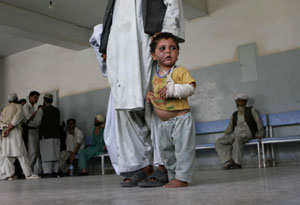
An Afghan boy injured in a coalition airstrike in July. (AP)

Are we bombing our way to disaster in Afghanistan?
ASK THIS | August 12, 2008

The low number of ground troops stationed in Afghanistan, combined with an increase in insurgent attacks, has resulted in a dramatic increase in the use of air power. But the resulting increase in civilian casualties is undermining battlefield success.


By Dan Froomkin
froomkin@niemanwatchdog.org

A new report from the Institute of Peace suggests that the massive increase in the amount of munitions being fired or dropped in Afghanistan has fueled popular anger -- and the Taliban resurgence. The report is called: Killing Friends, Making Enemies: The Impact and Avoidance of Civilian Casualties in Afghanistan.

The report’s co-authors, J Alexander Thier and Azita Ranjbar suggest some questions reporters should be asking about Afghanistan and the U.S. campaign there, what our goals are, and what tactics are likely to achieve them.

Q. The current level of aerial bombing in Afghanistan and the nature of the conflict there means that these bombings will inevitably cause civilian casualties. It is hard to say that we don't "intend" to cause these deaths when we know with a certainty that they will result from our actions. On balance, is the damage caused by these casualties in human and political terms worth the benefits of this approach?

Q. What are the benefits of the current approach? Is something achieved through aerial bombing that could not be achieved by capable ground forces?

Q. Given the current high level of civilian casualties, are collateral damage mitigation procedures being reassessed? Can these procedures be more effectively harmonized among all NATO forces?

Q. Some NATO forces have adopted a zero tolerance approach to civilian casualties, and can only call in an airstrike when forces are under attack. Does such a strategy give too much advantage to insurgents, or could such a policy be reasonably adopted by all NATO forces.

Q.  What factors would lead to a reduction or increase of bombing from this point forward? 

Q. What would be the impact of bombing in the tribal areas of Pakistan to take out terrorist and militant targets? In the past, civilian casualties resulting from such strikes have caused massive protests in an already fragile environment. 

-


Posted by Syed Qamar Afzal Rizvi
08/25/2008, 01:09 AM

A lamb-excuse terminology of collateral damage caused by the ongoing war on terror in Afghanistan and being also caused in Fata(Pakistan),can not exempt the US/Nato authorities from their cherished responsibilties of having an unjust policy adoption that has resulted in killing numerous innocent civilians in these areas.The US- fata policy seems highly incongruous with the dynamics of prescience and prgamatism.Any attemtp to crush the elements of extremism by dint of force, would cause more escalation in exterme tendencies.


-

Bruce Kushnick
Is basic American telephone service in a death spiral?
Bruce Kushnick questions whether AT&T and Verizon are trying to kill off the “plain old telephone service” that millions of Americans rely on. In a recent FCC filing cited by Kushnick, AT&T stated that landline utilities are from a bygone era, and asked to be relieved of its obligations to service them.

George Wilson
Obama gave a pass to out-of-control military spending
The GAO showed that contractors’ estimates have nothing to do with reality, and economic hard times may eventually force the President and Congress to rein in outrageously costly warships, planes and missile systems that don’t work. But that time isn’t here yet.

Martin Lobel
Some remedies for the Supreme Court power grab
It’s easy to find activism, impossible to find original intent behind the Roberts/Scalia group’s ruling on corporate political spending. Martin Lobel suggests six sharp, practical steps to deal with it.

Watchdog Blog
Barry Sussman
Scratch the Big Bonuses and Turn Them Over to Borrowers?
As an old assignment editor I’m used to asking questions and not being embarrassed if they expose me as naïve or wrong minded, because sometimes there’s a good story lurking. So here are a few simple questions. The biggest financial institutions are said to be on the verge of issuing $145 billion in bonuses. My [...]

Barry Sussman
A Simple Solution for Corporate ‘Free Speech’
A friend and contributor to Nieman Watchdog, Martin Lobel, sent this emaiI with the suggestion that people pass it along. Looks worth passing along to me. Here’s Marty: “I don’t know whether you’re as upset with the Supreme Court’s legislating in Citizens United v. FEC as I am, but there is a simple solution that is [...]

George Lardner Jr.
No 60 Votes Needed Here
Item: The New York Times reported Friday afternoon that “two more Democratic senators” said they would vote against a second term for Fed Reserve chairman Ben Bernanke. From there, the Times said this made it unclear “whether there were the 60 votes necessary to confirm Mr. Bernanke.” Excuse me? Sixty votes are not necessary to [...]

Blog main page >>
Web Essentials
Leading journalism sites, blogs...
Enter your e-mail address
Spotlight On

TWITTER
Follow Nieman Watchdog on Twitter.
(Nieman Watchdog)

Torture probe abandoned
For lack of interest, the Senate will not move ahead on the idea to appoint a commission to investigate detention, rendition and interrogation policies by the U.S. during the George W. Bush administration.
(Secrecy News)

Find John Brennan's op ed
Harry Shearer, working from a fantasy assignment desk, wants reporters to find a 2005 anti-Iraq war op ed that never was published.
(Huffington Post)

Those Mohammed cartoons
On Jan 2 a man with an axe tried to attack the Danish artist whose 12 depictions of the prophet Mohammed created a furor in 2005. After the failed attack, a Norwegian newspaper reprinted six of the drawings.
(Editors Weblog)

Afghanistan surge to rely heavily on private contractors
Private contractors are expected to make up at least half of the total military workforce in Afghanistan, according to Defense Department officials cited in a recent study from the Congressional Research Service. The number of contractors will likely increase by between 16,000 and 56,000 for a total of 120,000-160,000.
(TPM Muckraker)

Recession scars will be lasting
The aftershocks from deep recessions reverberate for years, even decades.
(USA Today)

The curious spending of a GOP pro-choice PAC
The money doesn't seem to actually go to supporting choice.
(Center for Public Integrity)

More Spotlights >>