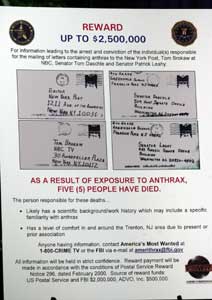
FBI reward poster. (AP photo)

Whatever happened to the anthrax letters?
ASK THIS | June 24, 2005

Four years after the deadly anthrax attack on media and government offices, much remains a mystery. Bioterrorism expert Leonard Cole has some questions for the investigators on the case.


By Leonard Cole

lcole1@ix.netcom.com


Q.  In November 2001, the FBI Web site indicated that the likely anthrax mailer was a disaffected loner who had access to a domestic laboratory.  Did the FBI prematurely conclude that the perpetrator(s) had no overseas connection?   Did the investigative focus on a domestic source diminish the pursuit of alternative possibilities?


Q.  In 2002, Steven Hatfill, an American research scientist, was named publicly by Attorney General John Ashcroft as “a person of interest” in the anthrax investigation.   Although no charges were brought against him, Hatfill has been unable to find work and has sued the U.S. government for violating his rights.  Why was Hatfill singled out and does the government owe him and the public an explanation? 


Q.  A federal court judge recently ruled that the government must comply with Hatfill’s request for information about its investigation into the source of the anthrax.  The government has not yet responded.  Just what is the status of the FBI’s investigation?  Why would making such information public compromise the investigation, as the government contends? 


Q. As a consequence of the anthrax letters, the nation’s 283 postal distribution and processing centers are being equipped with anthrax detection devices at a cost of about $600 million.  Why install a device that can detect anthrax but not other potential agents such as botulinum toxin and ricin?  


Q. Bill Paliscak a former postal inspector, unknowingly received a face-full of anthrax-laden dust while working in 2001, and then developed symptoms of the disease (including difficulty breathing, swollen joints, fatigue).  He remains very ill.  Since none of his laboratory tests were positive for anthrax, the Centers for Disease Control and Prevention (CDC) contends that his illness is unrelated to his exposure.  The CDC’s position has caused consternation to Paliscak and his family.  (See: After a Shower of Anthrax, an Illness and a Mystery, New York Times, June 7, 2005). Should the CDC not designate Paliscak a “suspect case,” a category included in the CDC’s protocol?   What is the basis for diagnosis and case definition of anthrax and other diseases?


Much about the deadly bioterror attacks in 2001 remains a mystery.  Perhaps a half-dozen letters containing powdered anthrax bacteria were mailed in the U.S. after Sept. 11.  The targets were largely news media and political officials.  Nearly 4 years later, neither the source of the bacteria nor the mailer(s) have been identified.  Nor is the motive for the attacks clear.  Nor is it clear why the four letters that were later found were all mailed from New Jersey—they were postmarked “Trenton, NJ.”  (Two were postmarked Sept. 18, and two Oct. 9.)  The recovered letters included praise for Allah and condemnation of America and Israel.  Whether that message was a ruse or a reflection of the sender’s true beliefs remains in dispute. 


In the course of the attacks, 22 people were diagnosed with anthrax.  Eleven contracted the cutaneous form and all survived.  But among the 11 who became ill from inhaling spores, five died.  The first fatal victim died on October 5 in Florida, and the last on November 21 in Connecticut.  Spores had leaked from the envelopes leaving a trail of contamination up and down the East Coast.  Scores of buildings were evacuated and underwent decontamination including congressional offices, the Capitol, newsrooms, and postal facilities.  More than 30,000 people at risk of exposure received prophylactic antibiotics, which doubtless saved lives.  All this havoc was wreaked by a volume of anthrax powder equivalent to a handful of aspirin tablets.  If the bacteria had been antibiotic-resistant and if hundreds of letters had been sent, the consequences could have been catastrophic.


-

The Anthrax Letters: A Medical Detective Story
Web site for Leonard Cole's 2003 book about the anthrax letters.

Martin Lobel
It’s time to do more than just say the economy is the No. 1 issue
If voters are to go into the midterm elections with any understanding at all, the press needs to get away from he-said, she-said reporting and look into the positions that candidates and the two parties are taking. Martin Lobel offers some vital questions.

William Claiborne
What a broken Senate looks like from far away...and why it matters
Our correspondent in Australia has ideas on how to improve things a little. But he’s not optimistic that anyone on Capitol Hill will be interested.

Steven Greenhut
How severe is the public employee pension problem across the U.S.? (Hint: Is a $3 trillion debt severe?)
Columnist and author Steven Greenhut looks at the ongoing pension issue, including abuses of it, and deals with some of the key questions.

Watchdog Blog
Herb Strentz
Des Moines Fair Coverage, Part 2
Cleaning up in the wake of the 2010 Iowa State Fair will be daunting this year. In addition to the mess left by nearly 1 million visitors and thousands of farm animals, we have a continuing saga of news coverage that told of possible racial assaults and then, in Saturday Night Live fashion, appears [...]

Herb Strentz
On ‘Beat Whitey Night’ in Des Moines
(Editor’s note: The incidents described here have become part of a developing story, as this Google link shows.) The Des Moines Register’s reluctance to identify criminal suspects or victims by race has turned into an outright refusal to do so. The closing night of the Iowa State Fair was marked by an observance not exactly on the [...]

Barry Sussman
Justice Department Shows Its Mettle, Indicts Clemens
I got this note from a friend and colleague a little while after Roger Clemens was indicted by a federal grand jury on Aug. 19th: “And meanwhile, Condoleezza Rice, Donald Rumsfeld, CIA officials and others who lied to Congress in sworn testimony about Iraq go free. If we can ‘look forward, not backward’ on torture, perjury, [...]

Blog main page >>
Web Essentials
Leading journalism sites, blogs...
Enter your e-mail address
Spotlight On

TWITTER
Follow Nieman Watchdog on Twitter.
(Nieman Watchdog)

Telecoms charging more to do nothing
It's getting more expensive to have an unlisted phone number. What's the logic behind that?
(Center for Media and Democracy)

Prosecute those leaks
The Obama administration has indicted another alleged leaker, this time for reportedly passing along to Fox News an intelligence assessment that North Korea was likely to respond to U.N. sanctions by conducting another nuclear test.
(Secrecy News/Federation of American Scientists)

A broad array of massive financial crimes
As PRWatch.org shows, court-imposed settlements have only skimmed the surface of big banks' wrongdoing in the financial crisis.
(Center for Media and Democracy)

More Spotlights >>