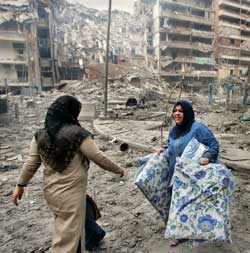
Lebanese women salvage belongings from their apartments after Israeli airstrikes in Beirut. (AP)

A reverse domino theory may be playing out in the Middle East
COMMENTARY | July 17, 2006

Gen. William Odom says Vice President Cheney has it all wrong when he warns that the U.S. must stay in Iraq because failure there could prompt collapse elsewhere. In fact, now it looks like a new Arab-Israeli war could be breaking out precisely because our actions in Iraq have emboldened Iran and Syria.


By William E. Odom
diane@hudson.org

Recently on national television, Vice President Cheney warned that withdrawing U.S. forces from Iraq would prompt the collapse of governments in other countries in the region, namely Pakistan, Egypt, and Saudi Arabia, putting them in the hands of radical Islamist rulers.

Cheney has it exactly backwards. Our continued entanglement is what is destabilizing the region.

The escalating conflict between Israel and Hezbollah and Hamas could become a new Arab-Israeli War. And it is precisely our actions in Iraq that have opened the door for Iran and Syria to support Hezbollah and Hamas actions without much to fear from the U.S.

Cheney’s assertion is a new version of the old domino theory which was invented to justify the U.S. military involvement in Vietnam. Were the Communists to win there, it was claimed, a series of other countries in Southeast Asia would also fall, like dominos, to the Communist bloc, making China extremely powerful and menacing. Laos and Cambodia did fall, more or less, to China's sphere, while Vietnam stayed with the Soviet Union. But the larger U.S. aim, the containment of China, was achieved, in spite of the United States, by Soviet and North Vietnamese actions against China. And the dire consequences of the domino theory that were so widely proclaimed by hawks at the time never came to pass.

We should have learned a number of things from the Vietnam War, but most of all that unintended consequences are often the most significant outcomes.  Our well-intended policies in Vietnam soon rendered the United States incapable of accomplishing anything positive in the region. Massive use of American combat power justified all of the extremism that North Vietnam used in pursuing its course, and most important, it removed all doubt about who could claim the banner of "national liberation" in Vietnam.  The Saigon government was soon seen as no more than America's lackey. Thus withdrawal from Vietnam actually improved America's strategic position for turning the tide against the Soviet Union, beginning during the Carter administration and accelerating during the Reagan administration.

In the succinct language of military strategy, strategic withdrawals often involve tactical defeats but open the way to counteroffensives and "strategic success." The domino theory, invoked to avoid "tactical defeats," can easily obscure the wisdom of a strategic withdrawal and instead pave the way to "strategic defeat."

Is the domino theory valid for the Middle East? No, not any more than it was in Vietnam. But a reverse domino theory is. The longer the U.S. stays in Iraq, the more likely the collapse of the secular regimes in those Muslim nations, and the more likely a full-scale war between Israel and its neighbors. It’s American departure from Iraq that could prevent it. 

Ironically, a "democratic domino theory" was one of the rationales Cheney invoked for the invasion of Iraq. In the mid-1990s, a small group of neoconservatives invented the idea of upending the entire Middle East region by imposing democracy in Iraq. They argued that other countries would follow. Now that elections in Iraq have stimulated civil war – and  put a Shiite majority in the position to revenge the wrongs they suffered at the hands of Saddam Hussein and to give Iran great influence in Iraq – the vice president has changed tunes. His enthusiasm for a "democratic domino theory" has also been dampened by recent election gains by Hamas in Palestine and Hezbollah's voting potential in Lebanon.

Now, according to this new theory, how does Mr. Cheney propose to stop these dominos – Pakistan, Egypt, and Saudi Arabia – from falling? By keeping U.S. troops in Iraq indefinitely. This is perverse.

The U.S. forces in Iraq opened the country to al Qaeda cadres, and democratic elections have cleared the way for radical rulers. The longer U.S. forces stay, the more likely it is that their radicalizing impact will reach beyond Iraq to Egypt and Saudi Arabia – and perhaps to Pakistan.  Not the other way around!

Tied down and strategically immobilized by its entanglement in Iraq, the administration has no credibility with most of its major allies. Only after it withdraws from Iraq and admits its own complicity in this spreading crisis will it be able to help stem the tide it has set in motion. Why? Upon our withdrawal, our allies will be far more likely to respond constructively to a U.S. bid to design a joint strategy for restoring regional stability in the Middle East. Decreasing the likelihood of more radical (and possibly undemocratic) regimes emerging in the Middle East requires a coalition of the major states of Europe and East Asia. It is beyond U.S. power alone.

The longer the United States keeps troops in Iraq, the greater that challenge will be. 

-

Lousy choices
Posted by Marty Schladen - reporter, The Galveston County Daily News
07/17/2006, 06:52 PM

I agree with Gen. Odom that our presence in Iraq destabilizes the region. But I worry about the consequnces of a pullout. A recent article in Foreign Affiars discussed the blowback that came after the Soviet pullout from Afghanistan. An U.S.-supported, battle-hardened, international group of Jihadists declared victory there and continued to wage "war" with the Trade Center bombings, the embassy attacks and a host of other depredations. What would they do if they convince themselves - and much of the Islamic world - that they were able to defeat the last remaining superpower? It would do wonders for recruitment and the immediate goal would be to install Islamist governments on the Arabian Peninsula, in Egypt and elsewhere. Thanks to this administration's arrogance and incompetence, we're nowleft to choose from an array of horrible choices.


Likely Outcome
Posted by Edward Rykowski -
07/18/2006, 10:33 AM

In the past, I have found myself in general agreement with the author's evaluations of the situation we have been creating for ourselves in Iraq. However, if our history in Vietnam is any guide (and I think it is), I doubt there will be substantial change in our policies in Iraq until a new administration is in the White House. Instead, I expect that, once again, an administration's political priorities will trump the national interest, delaying policy chnges that are obviously needed.


Motivation for Terrorists
Posted by Simon Meadowcroft -
07/27/2006, 01:27 PM

It seems to me that the current US administration is largely responsible for aiding Islamic Terrorist organisations recruitment efforts as an unintended result of their middle east policies.
Although previous administrations have added to middle east problems by providing support in the early days to both Sadam Hussain and Osama Bin-Laden. The current administration is set apart by its one-sided support of Isreal and its willingness to occupy other contries namely Afganistan and Iraq.
As a result of these policies they have in effect provided 3 key recriutment zones for future Islamic terrorists: Iraq, Afganistan and Palistine/Lebanon.
My worry about the current administation is that they seem to have sidelined all moderating elements, most notably Colin Powell who I believe would have followed a more balanced and pragmatic approach to Middle East policy.


-

Cheney's New Domino Theory
Dan Froomkin on an unusually revealing glimpse of Cheney's worldview.

What’s wrong with cutting and running?
Odom wrote in August that everything that opponents of a pullout say would happen if the U.S. left Iraq is happening already.

Want stability in the Middle East? Get out of Iraq!
Odom wrote in November that Bush says he wants to bring democracy and stability to the greater Middle East -- but the only way to achieve that goal is to get out of Iraq now.

Iraq through the prism of Vietnam
Odom wrote in March about the striking similarities between Iraq and Vietnam.

Bruce Kushnick
Is basic American telephone service in a death spiral?
Bruce Kushnick questions whether AT&T and Verizon are trying to kill off the “plain old telephone service” that millions of Americans rely on. In a recent FCC filing cited by Kushnick, AT&T stated that landline utilities are from a bygone era, and asked to be relieved of its obligations to service them.

George Wilson
Obama gave a pass to out-of-control military spending
The GAO showed that contractors’ estimates have nothing to do with reality, and economic hard times may eventually force the President and Congress to rein in outrageously costly warships, planes and missile systems that don’t work. But that time isn’t here yet.

Martin Lobel
Some remedies for the Supreme Court power grab
It’s easy to find activism, impossible to find original intent behind the Roberts/Scalia group’s ruling on corporate political spending. Martin Lobel suggests six sharp, practical steps to deal with it.

Watchdog Blog
Barry Sussman
Scratch the Big Bonuses and Turn Them Over to Borrowers?
As an old assignment editor I’m used to asking questions and not being embarrassed if they expose me as naïve or wrong minded, because sometimes there’s a good story lurking. So here are a few simple questions. The biggest financial institutions are said to be on the verge of issuing $145 billion in bonuses. My [...]

Barry Sussman
A Simple Solution for Corporate ‘Free Speech’
A friend and contributor to Nieman Watchdog, Martin Lobel, sent this emaiI with the suggestion that people pass it along. Looks worth passing along to me. Here’s Marty: “I don’t know whether you’re as upset with the Supreme Court’s legislating in Citizens United v. FEC as I am, but there is a simple solution that is [...]

George Lardner Jr.
No 60 Votes Needed Here
Item: The New York Times reported Friday afternoon that “two more Democratic senators” said they would vote against a second term for Fed Reserve chairman Ben Bernanke. From there, the Times said this made it unclear “whether there were the 60 votes necessary to confirm Mr. Bernanke.” Excuse me? Sixty votes are not necessary to [...]

Blog main page >>
Web Essentials
Leading journalism sites, blogs...
Enter your e-mail address
Spotlight On

TWITTER
Follow Nieman Watchdog on Twitter.
(Nieman Watchdog)

Torture probe abandoned
For lack of interest, the Senate will not move ahead on the idea to appoint a commission to investigate detention, rendition and interrogation policies by the U.S. during the George W. Bush administration.
(Secrecy News)

Find John Brennan's op ed
Harry Shearer, working from a fantasy assignment desk, wants reporters to find a 2005 anti-Iraq war op ed that never was published.
(Huffington Post)

Those Mohammed cartoons
On Jan 2 a man with an axe tried to attack the Danish artist whose 12 depictions of the prophet Mohammed created a furor in 2005. After the failed attack, a Norwegian newspaper reprinted six of the drawings.
(Editors Weblog)

Afghanistan surge to rely heavily on private contractors
Private contractors are expected to make up at least half of the total military workforce in Afghanistan, according to Defense Department officials cited in a recent study from the Congressional Research Service. The number of contractors will likely increase by between 16,000 and 56,000 for a total of 120,000-160,000.
(TPM Muckraker)

Recession scars will be lasting
The aftershocks from deep recessions reverberate for years, even decades.
(USA Today)

The curious spending of a GOP pro-choice PAC
The money doesn't seem to actually go to supporting choice.
(Center for Public Integrity)

More Spotlights >>